If you make candles, there’s one inexpensive tool that can save you from a lot of frustration and it costs less than $25. A heat gun can fix some of the most annoying candle making problems: sinkholes, uneven tops, poor adhesion, and more.
For container candles, a quick blast of heat before pouring helps prevent wax from pulling away from the glass. For molded candles, it makes it easier to release them cleanly from the mold. You can even use a heat gun to smooth out imperfections after pouring and to tidy up spills.
A heat gun is truly a game changer for candle makers. You don’t need anything fancy. Any basic model (or even a hair dryer) will do the job. Candle making supplies can be pricey, but this small, affordable tool is worth every penny. Here are 7 reasons you need a heat gun in your candle making toolkit.

1. To get smooth, even candle tops.
Nobody likes an uneven or lumpy candle top. Luckily, it’s an easy fix. A quick pass with a heat gun can re-melt the top layer and smooth out any imperfections, leaving you with a clean, even surface.
This trick is especially helpful when working with soy wax, which tends to cure unevenly (one of the many reasons I don’t love working with it). In the example below, you can see what a soy candle looked like before and after I used my heat gun. In this case, I waited until the candle had fully cured to re-melt the uneven top, but it’s actually even better to use the heat gun during the curing process. If you notice that the surface is starting to get uneven, a little heat while the wax is still soft can save you time later.
When I’m working with soy wax, I’m always ready to grab my heat gun for touch-ups. With paraffin or coconut wax, I can usually skip this step since they tend to cure much more evenly.


2. To pre-heat candle containers before the pour.
Never pour hot wax into a cool or room-temperature vessel. It’s one of the easiest ways to end up with sinkholes or wet spots. You’ll get a much better result if you pre-heat your vessels first.
Here’s why: candle wax naturally contracts as it cools, and the faster it cools, the more it contracts. That shrinking effect is what causes sinkholes. By warming your vessels before pouring, you slow down the cooling process and help the wax set evenly.
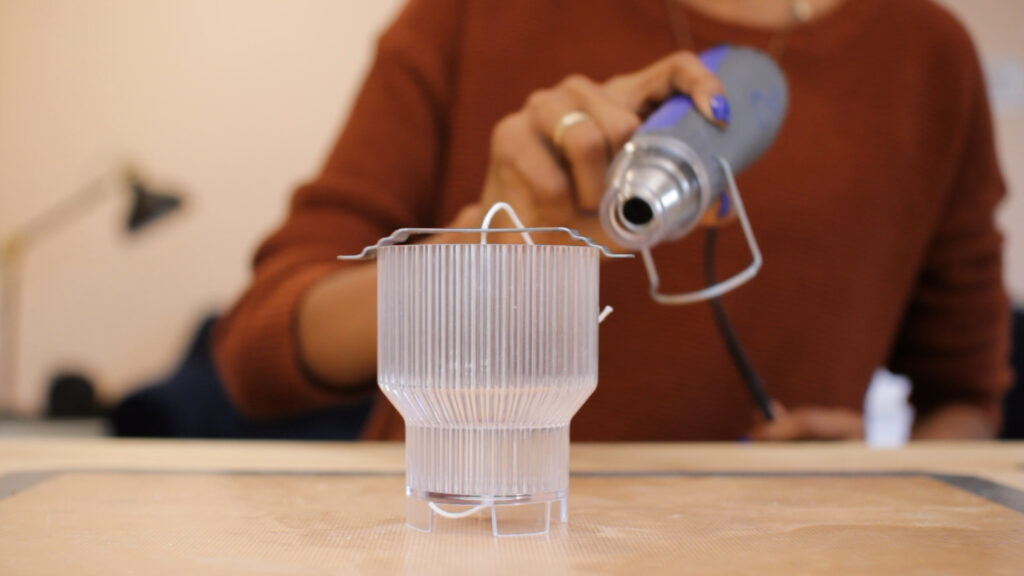
I like to pre-heat my jars and molds with a quick blast of hot air from my heat gun. I just move it back and forth across the sides of the container for a minute or two, until it feels warm to the touch. If you’re working on a larger batch, you can pre-heat your vessels in the oven for efficiency.

3. To fix sink holes.
If you failed to prevent a sinkhole from forming in the first place, you can fix it with a heat gun.
Again, sink holes are an issue caused by wax being forced to cool down too quickly. The wax contracts as it cools and in some cases, air pockets that are trapped under the surface of the candle collapse while the wax is contracting. This can leave anything from a minor dip in the surface to a pretty sizeable hole in the center of the candle.
To fix it, I like to first poke a toothpick or a wooden skewer through the sinkhole and into the wax beneath it. This helps open up any hidden air pockets. Then I aim my heat gun at the surface to re-melt the top layer of wax until it fills the sink hole and levels out. If you notice a sinkhole starting to form before the candle has completely cooled, you can also give the top a quick pass with the heat gun right away to help it level before it fully sets.
I’ve written an entire guide on fixing and preventing sinkholes (with a video showing the entire process) so check that out if you want more detailed troubleshooting tips and prevention methods.

4. To clean candle making tools and candle jars.
You can use a heat gun to remove leftover wax from candle jars, melting pitchers, or candle making tools. It makes cleanup so much faster. All you need is your heat gun and a few paper towels. Just warm the container or the tool until the wax melts, then carefully wipe it away.
I prefer this method over scraping because it’s cleaner, quicker, and gentler on tools and containers. It saves you from the mess of using the boiling water method or the freezer method (which I’ve written about in another post if you’re curious).
Pro tip: Don’t ever wash melted wax down the drain. It can clog your pipes! Instead, melt the leftover wax with the heat gun (or even a blow dryer in a pinch), wipe it clean with a paper towel, and then follow up with a little rubbing alcohol to remove any residue.
5. To remove air bubbles.
Air bubbles in melted wax can cause surface imperfections once the candle cures, so it’s best to deal with them right after you pour. The easiest way to do that is with a quick blast of heat. Just run your heat gun over the surface of the wax for a few seconds to pop any visible bubbles and smooth everything out.
If you’re making a container candle, gently tapping the sides of the jar can also help release hidden bubbles trapped beneath the surface. For molded candles, you can lightly tap the mold to remove bubbles or pour the wax slowly down the side of the mold to prevent bubbles from forming in the first place.

6. To prevent wet spots from forming.
Wet spots are not actually wet. They are spots where the wax doesn’t adhere to the sides of a glass jar properly and this looks like moisture trapped between the wax and the glass. Wet spots don’t affect how the candle burns or smells, but they do impact the look. This Malin + Goetz Tomato candle has a few wet spots, but it still smells great. That said, if you are a perfectionist like me and you want to avoid them from forming, get a heat gun!

When wax cools unevenly, it can pull away from the glass. This creates a pocket of air between the wax and the edge of the glass and it looks like a wet spot.
I sound like a broken record at this point, but preventing wet spots involves the same logic as the other common candle making issues I mentioned earlier. The goal is to slow down the cooling process so that the wax can properly adhere to the glass. You do this by pre-heating the jar before pouring. If you pour hot wax into a cool glass, the wax will contract quickly as it cools, which causes it to pull away from the sides. Warming the container first helps the wax stay bonded to the glass.
A few other ways to reduce wet spots:
- Cool your candles gradually. Make sure the room you’re working in isn’t too cold, turn off any fans, avoid any drafts, and don’t work on a cold surface.
- Let your wax cool to the optimal pouring temperature before pouring. It shouldn’t be piping hot.
- Pour slowly to minimize air bubbles and prevent uneven cooling.
7. To add wax embeds.
Decorative wax embeds are an easy way to upgrade a plain candle. I love using small molds (like flowers, fruit, shells, or even seasonal shapes) to make cute wax accents.

Just aim the heat gun at the area where you want to place the embed and let the surface wax soften slightly. That thin layer of melted wax will act like glue. Then, gently press your embed into place and hold it for a few seconds until it sets. You can also use the heat gun to lightly warm the back of the embed before placing it. This helps it to adhere even better and prevents it from popping off once the candle cools.
If you’re decorating a finished candle, keep the heat gun moving to avoid overheating the wax or warping the design. A short, even blast is all it takes to secure the embed.


Frequently Asked Questions
Here’s some more helpful tips and tricks for using a heat gun on candles.
What’s the best heat gun for candle making?
You don’t need anything fancy! The heat gun I use is only $25, and it works perfectly. Some models run up to $100, but that’s overkill for candle making. Here are my recommendations:
- Chandler Tool Store Heat Gun ($25)– This is the one I’ve been using since 2021 and it still works perfectly. It’s budget-friendly and reliable. It has 2 speed/heat settings: low speed & heat (300°C / 570°F) versus high speed/heat (400°C / 750°F). It only has one nozzle. It doesn’t have as many features as my other recommendation, but it does come in 5 different colors!
- Seekone Heat Gun 1800W ($37) – This is the one I plan to upgrade to when I need a new one. It has variable heat settings so you can select any temperature between 122°F-1202°F(50°C – 650°C). It even has a digital display that shows the temperature reading. And it has 4 nozzle options. It’s only a few more dollars than the one I currently use. This one is shaped more like a gun and does not have the metal arm to prop it up on the table, but it does have more features for only about $10 more than the one I’m currently using.
If you don’t go with one of these two, here are some must haves to look for:
- Adjustable temperature settings – Some heat guns have two settings: low versus high. Others have variable settings that allow you to dial in a specific temperature.
- Metal stand or arm – So that you can prop it up safely between uses.
- Built-in safety features – Overheat protection or auto shut-off are great for peace of mind.
And some nice-to-have features:
- Compact / lightweight heat gun – Easier to handle and control.
- Nozzle attachments – Help focus or diffuse heat for different tasks.
Can I just use a hair dryer instead?
Technically, yes. Any tool that blows hot air will work. That said, I definitely recommend investing in a heat gun.
The narrow nozzle on a heat gun lets you focus the airflow which allows you to be much more precise. This is especially helpful when you only need to heat a small section of the candle surface. With a hair dryer, you risk melting unintended areas or splattering wax.
If you’re in a pinch, a hair dryer can do the job but once you try a real heat gun, you’ll immediately see the difference.
Can I use a heat gun on all wax types?
Yes! You can safely use a heat gun with any wax type.
- For softer waxes like soy or coconut blends, stick to a low heat setting to avoid overheating or creating pits.
- For harder waxes like paraffin or beeswax, a higher setting works better for quick, even melting.
The key is to keep the heat gun moving and never hold it too close to the wax for too long. Gentle, even heat is the goal.
What are some heat gun safety tips?
Here are a few things to keep in mind:
- Never point the gun at your hand, face, or anything flammable.
- Always keep the gun moving—don’t let it sit in one spot too long.
- Use the heat gun on a non-flammable surface.
- Let the heat gun cool down before storing.