
The most important part of candle making is getting the temperatures right. If you want your candle to smell good, you have to add the fragrance oil at the right temperature. If you want your candle to look good, you have to pour the wax at the right temperature. These candle making temperatures vary by wax type, but there are a few general tips that will help you understand everything you need to know to make a great candle.

Melting point doesn’t matter that much.
The melting point will tell you when you can expect the candle wax to melt, but there’s nothing you have to do once the wax reaches that temperature. You do not have to add fragrance oil or dye at the melting point. You do not have to pour wax at the melting point. It’s just a number that lets you know when you can expect solid wax to become liquid.
Wax types with lower melting points will melt faster than ones with higher melting points, but there’s really not much more to it than that. Instead of paying attention to the melting point, you should focus on these two temperatures: (1) the best temperature to add fragrance oil and (2) the best temperature to pour the melted wax into the candle jar. More on that below!

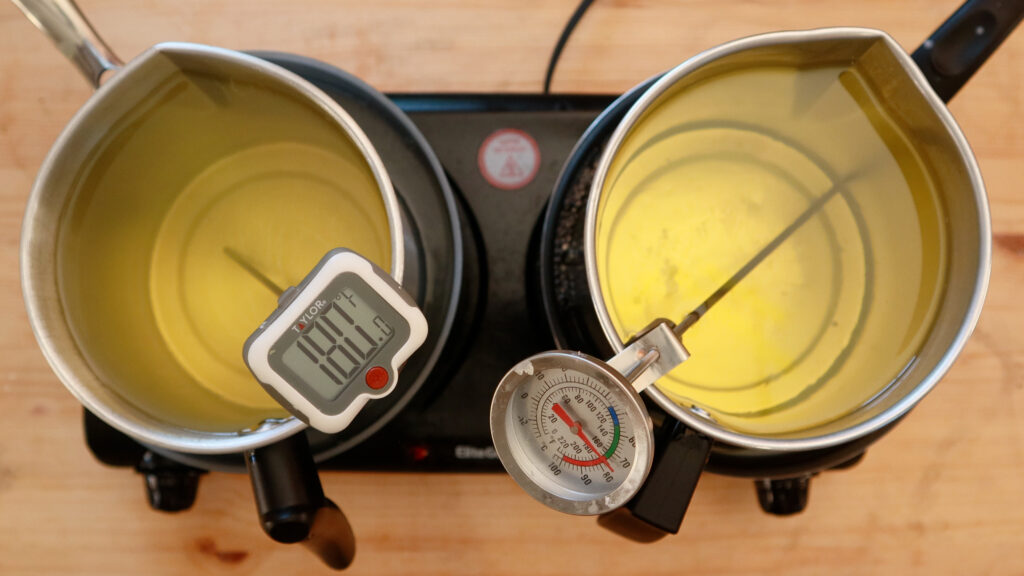
The best temperature to add fragrance oil is 185°F.
The best temperature to add fragrance oil is dependent on wax type, but a good target is generally between 180-185°F / 82-85°C. I use this temperature range for paraffin wax, soy wax, coconut apricot wax, and beeswax. It’s hot enough for the fragrance oil to fully blend into the wax, but not so hot as to degrade the quality of any of the ingredients. I’ve made hundreds of candles and I get the best scent throw when I add fragrance oil around 185°F.
If you add fragrance to wax that is too cool, it won’t fully bind.
Think of it like trying to add sugar to iced tea. It won’t fully dissolve. It might get a tiny bit sweeter, but you would get a better result if you added sugar to hot tea and then cooled it down.
The same thing happens if candle wax is too cool when you add fragrance oil. The oil won’t fully dissolve and you’ll end up with a candle that has a weak scent throw. Plus, the oil that doesn’t get fully absorbed into the wax may sit on the surface of the candle and cause safety issues later. Excess fragrance oil on top of a candle is flammable! Personally, I would avoid adding fragrance oil to wax that is cooler than your wax manufacturer’s suggested temperature (and generally not below the mid-170’s °F).
If you add fragrance to wax that is too hot, you might ruin both ingredients.
You should never overheat candle wax. Overheating degrades the quality of the wax and in extreme cases, smells really bad. I have accidentally overheated soy wax to 240°F and it started to give off smoke and smell horrible. I disposed of the wax and started over rather than adding fragrance oil. Most wax types do not need to be heated above 200°F. An exception is coconut apricot wax which some candle makers heat up to 215°F -225°F to add fragrance oil. I personally don’t go this high because I’ve always gotten great results at 185°F.
There is some debate among candle makers about what happens to the fragrance oil when it is added at really high temperatures. Some claim that the oil vaporizes before it gets a chance to bind with the wax and others think that it fails to fully absorb into the wax due to heat shock. I can’t confirm whether either of these scenarios is true because I have always disposed of overheated wax. You could absolutely test out adding fragrance oil at 190°F, 195°F, and 200°F just to see if you get a better scent throw for the particular wax type you are using, but I would not recommend adding fragrance oil at temperatures much higher than 200°F if you’re using soy, paraffin, or beeswax.


You do not need to worry about the flash point...
…but you should know what it means. The candle wax and the fragrance oil both have a “flash point” which is basically the ignition point. It’s the temperature at which an ingredient could be ignited if it were exposed to a flame. You will probably never heat the wax or the fragrance oil up to its flash point, but it’s a good idea to understand when they might make things more flammable.
Don’t overheat wax. The flash point makes it flammable during the candle making process.
Flash points vary by wax type, but they are all very high temperatures – most are well above 350°F/176°C. You will probably never have to worry about heating your wax up to that point, but just be aware that it is dangerous to do so. Even though the risk of fire is minimal, there is still a risk. That’s why it’s important not to leave melting wax unattended. Make sure to monitor the temperature periodically to avoid overheating the wax, not just because it can ruin the quality but also because it’s a safety issue.
Don’t overload the candle with too much fragrance oil. The flash point makes it flammable while the candle is burning.
Fragrance oil flash points are much lower than wax flash points, but the main concern with flammability is not during the candle making process. It’s once the candle is actually burning.
If you add too much fragrance oil, it won’t completely bind with the wax. Excess oil droplets can sit on the surface of the candle. When you burn it, you’re exposing those droplets to a flame that can potentially ignite the oil. That is why Trader Joe’s had to recall their Mango Tangerine candles in 2024 – a bad batch caused fires for some of their customers because the flame jumped from the wick to the wax.
Just pay attention to the recommended fragrance load and you should be fine. It’s typically around 10%. The candle supply company will have this information on their website. It’s usually also printed on the bottle. If you need help calculating how much fragrance oil to use in a candle, bookmark my fragrance oil calculator. All you have to do is enter the wax weight and the desired fragrance load. The calculator will tell you exactly how much fragrance oil to use.


The best temperature to pour wax is probably cooler than you think.
Don’t pour piping hot wax into a candle jar! Wax contracts as it cools and the faster it is forced to cool down, the more likely you are to see cosmetic issues like dips in the surface of the candle. The pouring temperature affects the candle’s appearance. Pour too hot? You’ll get a sink hole. Pour too cool? You’ll get jump lines. If you want a beautiful candle with a smooth top, you have to get it just right.


After you’ve added fragrance oil at 185°F, remove the wax from whatever heat source you are using and let it cool down to the right pouring temperature. You should always check the candle supply company’s guidelines for the ideal wax pouring temperature because it varies by wax type. Their recommendation is a good starting point, but the only way to know for sure is trial and error.
Here’s how I figure out the ideal pouring temperature:
- After I pour a candle, I write down the pouring temperature I used. If it’s the first time I’m testing out a new wax type, I’ll start with the temp provided by the manufacturer.
- After the candle cures, I inspect it. If the candle has a dip in the middle, I will pour cooler the next time. If it has white lines along the sides, I will pour hotter the next time. If it has a smooth top, I got it just right.


My advice is to take notes! I like to write down the date that I poured the candle, the wax type I used, the temperature at which I added fragrance oil, the fragrance load, and the pouring temperature. Sometimes, the supplier’s temperature recommendation works for me on the first try and sometimes it doesn’t. Testing is a necessary part of candle making.
Get a thermometer that you can attach to the pitcher.
This one’s a quick tip! It doesn’t matter whether you go for digital or analog. Just get any thermometer that has a clip so that you can attach it to the pitcher. You won’t have to dip the thermometer into the wax every time you want to check the temperature. If you clip it on, you can get continuous readings.
Temperature is honestly the most important part of candle making so make sure you’re set up to know what it is at all times!


Helpful Resources + Next Steps
Don’t be overwhelmed by all of the information in this post. Here’s how to get started!
- If you want to make candles in your kitchen, you’ll need to know how to double boil candle wax. If you want a different wax melting method, I have a guide to 3 different ways to melt candle wax.
- I also created a tutorial on how to make the perfect scented candle. It is super detailed and beginner friendly!
- And don’t forget to bookmark my fragrance oil calculator for an easy way to calculate exactly how much wax and fragrance oil to use in any candle.
My best advice is to take notes every time you’re testing new candles! I always write down my temperatures and other important details each time I test a new candle. After the candle cures, I burn it to see how it performs. If it performs well, I replicate exactly what I wrote down on the note card. If it doesn’t perform well, I make adjustments. Experiment with different temperatures, wax types, wick sizes, fragrance loads, and candle jars until you get it right. Good luck!


